Why Building Confidence Doesn’t Fix Low Self-esteem
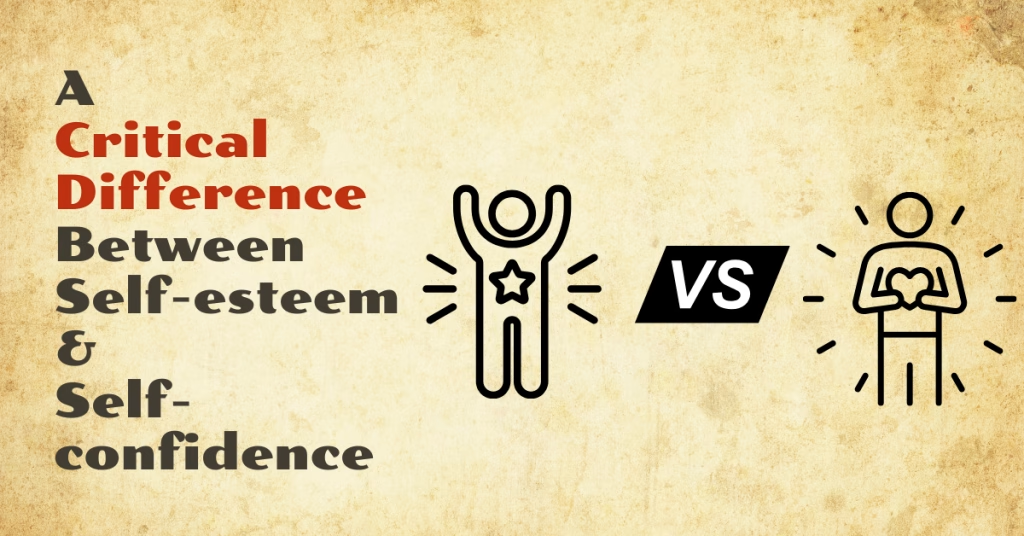
Self-esteem and self-confidence are not two strengths of the same feeling. Self-esteem is your sense of worth, the quiet answer to whether you are enough as you are. Self-confidence is your sense of ability, the answer to whether you can handle what’s in front of you. Most people use the two words interchangeably, and most advice does too, which is exactly why so much confidence-building work leaves a person’s self-esteem completely untouched.
A person with low self-esteem carries a running suspicion that something about who they are is wrong. It shows up as chronic self-criticism, a habit of discounting compliments, and a private sense of being a fraud even in the middle of success. None of this is really about what the person can do. It’s about who they believe they are being underneath what they do.
Why Psychology Rarely Separates the Two
Most psychological models don’t clearly separate being from doing when they talk about self-esteem, confidence, or motivation. This is one of the field’s oldest blind spots. The self, in mainstream psychology, is usually built out of thoughts, behaviors, and social feedback, so self-esteem becomes a belief about your worth and self-confidence becomes a belief about your abilities. Different subjects, treated as the same cognitive process.
Behaviorism reduces the self to observable actions and reinforcement, so there’s no real concept of an inner being to begin with. Cognitive psychology treats the self as a set of schemas and thoughts, so self-esteem becomes a mental evaluation rather than an expression of identity. Humanistic psychology comes closer. Even so, Carl Rogers and Abraham Maslow described identity through self-concept and self-actualization rather than a deeper, intrinsic source. Motivation theories fare no better: Albert Bandura’s self-efficacy, Edward Deci and Richard Ryan’s competence, and Carol Dweck’s growth mindset all focus on performance, belief, or environmental support. None of them draw a clear line between the inner source of worth and the outer display of skill.
Because of this, low self-esteem and low self-confidence get treated as nearly the same problem. A person who feels unworthy gets told to build confidence. A person who doubts a specific skill sometimes gets diagnosed with a self-esteem issue. Both get filed under cognitive distortion instead of being recognized as two different kinds of experience, one rooted in being and one in doing.
This is one of several places where Western psychology’s clinical starting point differs from the Continental tradition, which begins by understanding a person’s inner world before applying any technique to it. Authentic Systems grew out of that second tradition. Being is the internal source of worth, the Life Theme, the felt sense of identity that can’t be earned or lost. Doing is the skill and strategy used to function in the world. Self-esteem comes from alignment with the first. Self-confidence comes from alignment with the second. When the two get mixed, a person can no longer tell whether they’re doubting themselves or doubting their abilities, and that confusion is exactly what keeps confidence-building from ever touching self-esteem.
Can You Have Confidence and Still Have Low Self-Esteem?
Yes, and it’s more common than most people expect. A surgeon can walk into an operating room with total certainty in her hands and still go home unable to shake the sense that she doesn’t deserve the life she’s built. An actor can command a stage and collapse the moment someone questions his character rather than his performance. Confidence and self-esteem don’t rise and fall together because they aren’t measuring the same thing.
This is why performance success so rarely heals a sense of inadequacy. A person can rack up achievement after achievement, get better at everything they attempt, and still wake up every morning doubting their worth, because the achievements were never the problem in the first place. Confidence is earned in the world of doing. Self-esteem is only restored in the world of being.
What Low Self-Esteem Feels Like
Low self-esteem is directed at your sense of being, at who you are rather than what you do. It tends to show up in patterns like these:
- Criticism lands hard because it feels like confirmation of something you already believed about yourself.
- Compliments are difficult to accept because they contradict the story you’re already carrying.
- People-pleasing becomes a habit, driven less by generosity than by a need to avoid rejection.
- Shame sits in the background of most relationships, feeding a quiet cycle of comparison.
- Even a stable life can feel fragile, because a small amount of stress is enough to overwhelm someone without a strong inner sense of value.
Underneath all of it is a struggle with identity itself: what you want, who you are, what you stand for.
Self-esteem is the emotional floor beneath the sentence “I am.”
When that floor is unstable, everything built on top of it feels unstable too.
What Low Self-Confidence Feels Like
Low self-confidence doesn’t touch identity the same way. It shows up around performance and skill, in specific situations rather than across your whole sense of self.
- Instead of thinking “I’m not worthy,” the thought is closer to “I’m not capable.”
- Tasks bring anxiety before they even start.
- Challenges get avoided, or initiative gets delayed until the odds feel safer.
- Preparation runs long, sometimes far past what the task actually requires.
- Mistakes feel technical rather than personal, because the doubt was never about worth to begin with.
Confidence also behaves differently than self-esteem in one important way: it grows as skill grows. You can be entirely confident in one part of your life and unsure in another, because confidence is situational. Self-esteem, when it’s shaky, tends to touch everything.
Why Building Confidence Doesn’t Touch Self-Esteem
Inside the Authentic Systems framework, self-esteem reflects the stability of your authentic identity, your felt connection to your Life Theme. When self-esteem drops, you’ve lost touch with your internal source of value, not your skill set. Self-confidence works differently. It’s tied to external performance, to whether a task lines up with your Life Theme in the first place.
A Power Theme might feel entirely in command during a competitive negotiation and strangely uncertain in a quiet, emotional conversation. A Love Theme might move easily through relationships and falter the moment a conflict turns high-stakes. Neither fluctuation says anything about a person’s worth. Both are simply signals of whether someone is operating inside or outside their natural motivational mode.
That’s the reason confidence-building programs so often fail to reach self-esteem. They’re aimed at the wrong layer. Teaching someone a new skill, a better posture, or a sharper way of speaking can absolutely raise their confidence in that specific arena. It does nothing for the deeper question of whether they believe they’re allowed to take up space in the world at all.
You can’t skill your way into feeling worthy, because worth was never a skill.
What Actually Rebuilds Self-Esteem
If self-esteem lives in being rather than doing, then it can’t be repaired with better performance. It has to be repaired at the level of identity, by reconnecting with the Life Theme that generates your sense of worth in the first place.
For most people, that reconnection starts with a simpler question than any confidence exercise asks: what motivated you before anyone taught you what you were supposed to want? Children don’t manage their self-esteem. They simply express whichever Life Theme, Love, Justice, Wisdom, or Power, already belongs to them. Self-esteem tends to erode later, usually after years spent in a role, a relationship, or a career that has nothing to do with that original motivation. The doubt was never really about worth. It’s about distance from the source of it.
This is the work behind the Life Theme Analysis and the ALTA Assessment: identifying which of the four Life Themes is actually yours, then tracing where daily life has drifted from it. Once that distance becomes visible, self-esteem tends to recover on its own, not because a person became more confident, but because they stopped trying to become someone their identity was never built to be.
None of this replaces the value of skill. Confidence is still worth building, and competence still matters in the world of doing. It just isn’t the same project as rebuilding self-esteem, and mistaking one for the other is why so many people work hard at confidence for years without ever feeling more at home in themselves.
The Bird That Doesn’t Know It Can Fly
I was once told that discovering your Life Theme is like being a bird in a dream. Birds don’t carry a sense of self the way we do. They fly because flight is instinct, not because they’ve built confidence in their wings. Imagine you were that bird in the dream, and you suddenly understood what your wings could do. You’d want to know how high you could climb, how fast, whether you could bank hard to the left or roll upside down and feel the air move under you on purpose instead of by accident.
That’s the difference between knowing your Life Theme and not knowing it. Confidence can teach you to fly a pattern you’ve memorized. Self-esteem is what lets you feel, all the way down, that the sky was always yours to begin with.
Frequently Asked Questions
Self-esteem is your sense of worth, how you feel about who you are underneath what you do. Self-confidence is your sense of ability, how capable you feel of handling a specific task or situation. One belongs to identity. The other belongs to performance.
Yes. Confidence is situational and grows with skill, while self-esteem is a broader sense of worth that doesn’t automatically improve with achievement. It’s entirely possible to feel highly capable in your work and still carry a deep, private sense of not being enough.
Not by practicing confidence. Self-esteem rebuilds when you reconnect with the identity and motivation, what Authentic Systems calls your Life Theme, that generated your sense of worth in the first place, and then close the distance between that identity and how you’re actually living.