
The Four Archetypes as Life Themes

Exploring the four archetypes as life themes helps explain how these timeless symbols shape identity and guide the course of a life. Archetypes are living symbols, capturing the essence of human behavior through roles that appear again and again across mythology and lived experience.
There are four universal motivating archetypes of identity, or what I call the Four Life Themes. Your actions are guided by a dominant Life Theme, one of these four archetypes. This Life Theme runs deeper than personality. It drives and motivates a person throughout an entire life.
This article covers all four archetypes as life themes and why understanding your dominant Life Theme Archetype matters this much for personal happiness, success, and self-awareness.
- The Four Archetypes as Life Themes Are: Love, Justice, Wisdom, Power
- Benefits of Knowing Your Life Theme
- Not the Same as a Personality Type
- Life Themes Throughout History And Today
- Knowing Which of the Four Archetypes Is Your Life Theme Brings You Closer to Your Purpose
- Finding Your Life Theme
- Frequently Asked Questions
The Four Archetypes as Life Themes Are: Love, Justice, Wisdom, Power
Different cultures have used different labels to describe the four archetypes, but their qualities and essence remain the same. I chose the terms Love, Justice, Wisdom, and Power based on multiple historical references that divide humanity into four domains.
Ask a group of people what motivates them daily, and you’d hear a wide range of answers. Some would say the drive to make the world better guides their actions. Others would say making money or building a stable life for themselves and the people they love is what matters most.
People could give dozens of different answers about what motivates them, but the reality is that there are four primary motivators in life. Regardless of personality, upbringing, age, where someone lives, or any other factor shaping their beliefs, everyone is motivated by one of four things: Love, Justice, Wisdom, or Power.
Here’s a brief breakdown of each of the four archetypes as Life Themes:
- The Love Theme is motivated to better humanity by correcting what causes pain, discomfort, suffering, and victimization. It’s driven by love, compassion, and empathy. A Love Theme might express this through volunteering for a cause that matters to them or caring for the people close to them.
- The Justice Theme seeks balance and harmony. This Theme combines Love and Wisdom. It works to correct injustice and imbalance in people, relationships, and organizations, and it also shows up through the pursuit of harmony and perfection in design, whether that’s engineering, writing, painting, or music. Justice Themes combine what humanity needs with factual information and new ideas.
- The Wisdom Theme is driven by a need to know and to solve problems for others. Wisdom finds its expression through teaching, learning, and working with data. People with a Wisdom Theme often light up when they get lost in a book or dig into a topic that interests them.
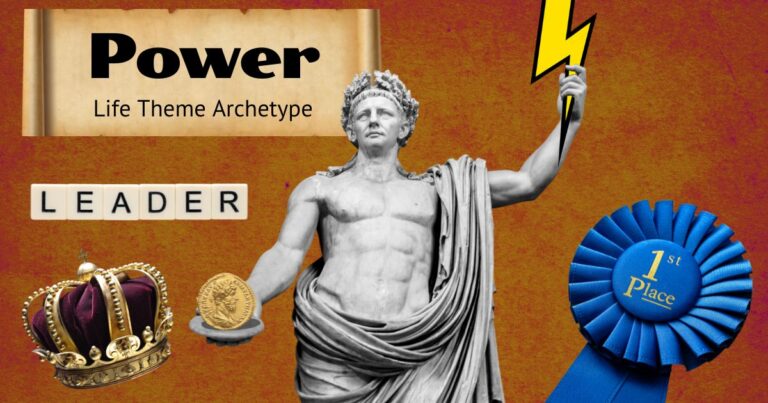
- The Power Theme needs to act on thoughts and get into motion. Power finds purpose as a natural leader and agent of change. A Power person might express this by seeking leadership roles or positioning themselves in positions of authority, and they often acquire tokens of power like money, awards, diplomas, or property.
It’s worth understanding that you do possess, and express, parts of all four Life Themes, even though one dominates your overall expression. If you’re a Love Theme, that doesn’t mean you’ll never show traits of a Wisdom Theme. Your Life Theme is simply the one motivating factor that dominates and outweighs the others. It functions like a living symbol you express through daily life.
Get the full breakdown of Love, Justice, Wisdom, and Power.
We all need to express the four Archetypes as Life Themes, regardless of upbringing, opportunity, or physical circumstance. We show Love when we’re compassionate toward people and figure out how to cooperate with others whose views differ from our own. We exhibit Justice when we build relationships that are mutually beneficial and focus on moral, ethical solutions to real dilemmas. When we ask questions and seek out new information, we’re creating meaning and showing Wisdom. And when we adjust course and create change around us, we’re showing our Power.
Benefits of Knowing Your Life Theme
Your Life Theme motivates you toward developing a single, coherent sense of Authentic self. Every experience gets tethered to this one source, acting as a filter that selects what does and doesn’t conform to your Life Theme. Your Life Theme, in other words, is the actual criterion behind the creation of the authentic self.
Many people struggle to make decisions, something often called decision fatigue. In my work with clients, this seems to be showing up more than it used to, though the research on decision fatigue itself is genuinely mixed, some studies find strong evidence for it, others don’t. What I do see consistently is that people who struggle with decision fatigue usually lack a strong sense of which choices actually move them toward their goals.
It’s also common for people not to know what their real, life-guiding goals even are. And without knowing what you want, how do you make a decision that actually points you in the right direction?
The answer is that you can’t make a genuinely informed decision without knowing what you want, and more importantly, why you want that outcome. Otherwise, you’re just hoping you’ll stumble into something that makes you happy by luck.
Once you know your Life Theme, you stop choosing your next steps on a whim. Instead, you make decisions rooted in your true motivations. Each Life Theme Archetype values very specific things, and knowing those values shapes the goals you set, the tasks you prioritize, and the decisions you make every day.
You naturally hold yourself accountable for your choices once you recognize what genuinely motivates you. When you take steps that don’t align with your Life Theme, understanding your Theme makes it easier to course-correct and refocus your time and energy on what actually matters to you.
Your Life Theme also provides the boundaries that shape how you perceive the world around you. Through your Theme, you find the stability needed to build a coherent understanding of life despite how chaotic the world can feel.
There’s a reason we’re designed with Life Themes. Without one, we wouldn’t have a uniform, reliable view of the world. Imagine how hard it would be to make plans or set goals without being able to depend on your own worldview. You’d feel lost and disoriented, unable to trust your own judgment.
Life Themes also direct the experiences responsible for constructing your Authentic Identity.
Not the Same as a Personality Type
It’s worth being precise about what a Life Theme is not. Frameworks describing four fundamental personality types have existed for centuries; the Four Temperaments (Choleric, Sanguine, Melancholic, Phlegmatic) being the best-known example, tracing back to ancient Greek medicine. Those systems describe behavioral style: how someone tends to act, communicate, and respond under pressure.
A Life Theme describes something underneath that. It’s not about how you behave. It’s about what you’re fundamentally motivated to correct, protect, or pursue in the world, a force that can express itself through many different behavioral styles depending on the person. Two people can share the same Life Theme and look nothing alike in personality, or share a personality type and be driven by entirely different Life Themes. I go into this distinction in more depth in Personality Types Versus Archetypes, if you want the fuller comparison.
Life Themes Throughout History And Today
Your true identity lives within the four archetypes, also understood as universal virtues: Love, Justice, Wisdom, and Power. These virtues are an intrinsic part of the human condition. My research has traced the historical presence of four universal, innate sources of motivation, what I’ve labeled Life Themes, through writings from the ancient Egyptians, Native Americans of North America, global Shamans, authors of holy texts, European philosophers, and psychotherapists.
We can see these Themes reflected in the Toltecs, a civilization that flourished in central Mexico roughly between 950 and 1168 CE. Their surviving records reveal how powerful a Life Theme is in a person’s life and how much it matters to know what actually motivates you.
Since most information on the Toltecs comes down to us through the Aztecs by way of oral tradition, the record is incomplete. Still, careful examination of earlier Mayan texts and surviving archaeological evidence has outlined the main elements of this civilization.
The Toltecs saw the Love Theme in Healers of the body and soul, the Wisdom Theme in Teachers, the Justice Theme in Visionaries, and the Power Theme in Warriors. Any one of these Themes could show up differently depending on the person embodying it. One Warrior might focus on exploring the landscape, while another might primarily take on the role of protector.
Just as the Toltecs expressed their Life Themes in their own way, so do we today. You can often spot your own Life Theme by looking at the objects you choose to surround yourself with.
How does that work? The pieces people choose to fill their living spaces tell a story about how they want to be perceived and the kind of life they want to lead. Artwork, trinkets, and other décor all offer clues into someone’s values and interests.
A Wisdom person who loves reading and wants to be seen as intelligent and curious might surround themselves with philosophy books. A Power person who wants to be seen as glamorous might fill their home with expensive furniture as a display of wealth.
Possessions can shape identity and offer a way to express it, too. A Love person might surround themselves with photos of family and friends, or build scrapbooks for themselves and others, as a way to express deep feelings of compassion and care. A Justice person might keep an array of art supplies that let them create balance through the art they make. Even clothing can be telling: a Power person who cares about status and appearance is more likely to wear tailored, name-brand clothes, while a Love person who values comfort and shared activities with friends tends to care less about fashion. What people buy, and how they present themselves, shows the world what they value and what they don’t.
Knowing Which of the Four Archetypes Is Your Life Theme Brings You Closer to Your Purpose
Over time, I’ve noticed, both in myself and in my clients, that the more someone connects with their Life Theme, the stronger their intuition becomes and the easier it gets to know their true purpose in life. Those strong gut feelings you sometimes get about a decision are your Life Theme at work. The more you align your life with it, the more often you’ll notice that clear, unmistakable sense of “just knowing.”
Your Life Theme communicates through gut feelings, hunches, and unexplainable pulls toward certain people, places, and activities, sending you signals that help you live in a way that expresses your Theme and moves you toward your purpose. The more you take heed of these signals and follow them, the more easily your Theme can reach you. It’s like any relationship. The more you participate, the closer you become to it. Get close enough, with good enough communication running between you and these four archetypes, and it can start to feel almost mystical. Moments of clarity and synchronicity tend to increase.
If you live counter to your Life Theme Archetype, though, you’ll have less access to what it’s trying to tell you, and your intuition will feel noticeably weaker. Say you have a Love Theme, but instead of living as an advocate for humanity, you’re stuck in a job or relationship that forces you to be the one who punishes people or dismisses their feelings. You’ll lose connection to your intuition in that role. You’d likely feel miserable and lost, cut off from the guidance your Life Theme was trying to offer. It would still be communicating. You’d just have a much harder time hearing it.
I came to these conclusions after twenty years of watching clients live out the same pattern again and again. Their lives changed in ways they couldn’t have anticipated the moment they left jobs or relationships that clearly didn’t fit their Life Themes. Once they found a role better suited to who they actually were, they could hear their intuition clearly again.
Ultimately, a fulfilled life is one that expresses your Life Theme. That’s what brings real happiness, contentment, and well-being. When you’re truly fulfilled, you give your unique gifts to the world, express your true Authentic Self, and have that truth recognized by the people around you.
Finding Your Life Theme
Reading about the four archetypes can tell you which one probably fits. Actually confirming it, with enough precision to build real decisions on, takes a more structured process than a blog post can offer.
That’s exactly what a Life Theme Analysis or the ALTA Assessment is built to do: identify your dominant archetype with real confidence, then show you where your current life already lines up with it, and where it doesn’t.
From here, explore each of the four archetypes individually:
- Love Archetype As a Life Theme
- Justice Archetype As a Life Theme
- Wisdom Archetype As a Life Theme
- Power Archetype As a Life Theme
Frequently Asked Questions
What are the four archetypes as Life Themes?
The four archetypes are Love, Justice, Wisdom, and Power, four universal motivating forces that shape identity and behavior. Everyone expresses all four to some degree, but one typically dominates and becomes a person’s Life Theme, the deepest, most consistent driver of their choices across an entire life.
How do I know which archetype is my Life Theme?
Look at what you consistently find yourself drawn to correct, protect, understand, or act on, not just what you enjoy, but what you can’t help caring about. A Love Theme centers on reducing suffering, Justice on restoring balance, Wisdom on understanding, and Power on driving change. A structured process like a Life Theme Analysis can identify it with more precision than self-reflection alone.
Are Life Themes the same as personality types?
No. Personality frameworks like the Four Temperaments describe behavioral style, how someone tends to act or communicate. A Life Theme describes what motivates that behavior in the first place. Two people can share a personality type and have completely different Life Themes, or share a Life Theme and look very different in personality.


13 Comments