
Archetypes vs. Personality Types: The Difference Between How We Behave and What Motivates Us

Personality tests are useful because they can tell us a great deal about how we tend to behave. They may describe us as analytical, outgoing, cautious, agreeable, decisive, introverted, highly organized, or emotionally expressive. These descriptions can be accurate and helpful, particularly when we are trying to understand communication styles, workplace behavior, relationships, or decision-making.
But personality leaves an important question unanswered.
Why does a person behave that way in the first place?
That question is where archetypes become interesting.
The distinction between personality types and archetypes is not simply that they are two different systems for categorizing people. They are attempting to describe two different levels of human experience. Personality generally describes patterns in how people act, respond, communicate, and interact with the world. Archetypes, as I use them, point toward something deeper: the underlying motivational orientation that makes certain experiences matter to a person in the first place.
In simple terms, personality tends to describe how we do things. Archetypes help explain why we are motivated to do them.
That difference becomes especially important when we move beyond describing behavior and begin asking questions about identity, meaning, and purpose.
Personality Describes What We Can See
Most personality systems begin with patterns that can be observed or reported. The Myers-Briggs Type Indicator, DISC, the Big Five, and other personality frameworks look at recurring differences in the ways people think, communicate, make decisions, relate to others, or respond to their environments.
These systems can be extremely useful within their intended purpose.
If someone is consistently reserved, highly analytical, methodical, detail-oriented, and comfortable working alone, a personality assessment may capture that pattern quite well. It gives us language for describing the way that person typically operates.
What it does not necessarily tell us is what motivates the person underneath those behaviors.
Two people may both be analytical and detail-oriented, but one may be driven by a need to understand how something works while the other is driven by a need for balance, precision, and correctness. Their behavior may look similar from the outside, but the experience taking place inside them can be very different.
The opposite is also true. Two people may have completely different personalities but be motivated by the same underlying concern.
One person may be quiet and reflective. Another may be energetic and highly social. Yet both may spend their lives pursuing knowledge, explanation, and understanding. Their personalities are different, but the motivational theme running through their lives may be remarkably similar.
This is one reason behavior alone can tell us only so much.
Archetypes Begin With Motivation
When I work with archetypes, I am less interested in asking, “What kind of behavior does this person display?” and more interested in asking, “What consistently moves this person?”
- What do they find compelling?
- What do they repeatedly notice?
- What kinds of situations energize them?
- What frustrates them more than it seems to frustrate everyone else?
- What kinds of experiences leave them feeling deeply satisfied?
- What do they continue to pursue even when there is no obvious reward for doing so?
These questions bring us closer to archetypal orientation and motivation. The four archetypal orientations I work with are Love, Justice, Wisdom, and Power.
Love is oriented toward connection, attachment, care, and well-being. This is broader than simply being kind or nurturing. Love may express itself through family, friendship, animals, community, beauty, protection, loyalty, or anything that carries the experience of connection and care.
Justice is oriented toward balance, proportion, fairness, consistency, and right relationship. It can appear in law and ethics, but it can also appear in mathematics, design, accounting, architecture, music, negotiation, systems, and anywhere balance or proper relationship becomes significant.
Wisdom is oriented toward knowledge, understanding, explanation, and discovery. It may be expressed through scholarship, science, mechanical aptitude, philosophy, collecting, teaching, research, history, or any sustained pursuit of understanding.
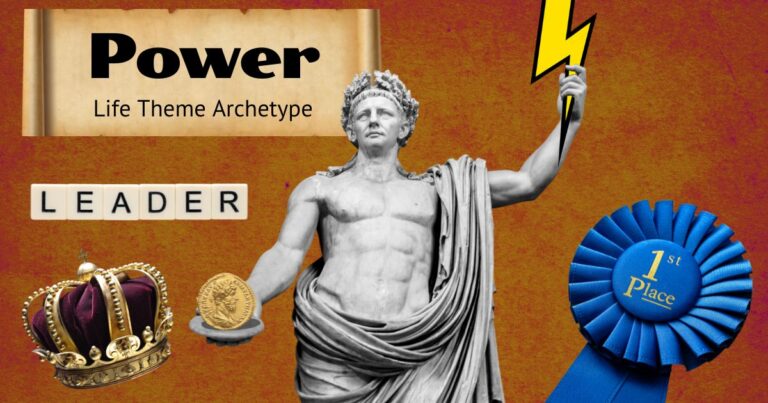
Power is oriented toward agency, influence, effectiveness, and bringing about change. It can appear in leadership, entrepreneurship, politics, construction, athletics, engineering, management, negotiation, or any situation in which the ability to produce an outcome becomes important.
None of these Life Theme Archetypes tells us exactly what someone will do. They tell us what kinds of experiences are likely to carry particular motivational weight.
A Life Theme Archetype is not a personality description. It does not tell us whether someone is introverted or extroverted, friendly or stern, organized or spontaneous. It does not determine someone’s occupation or political beliefs. It does not dictate what someone will do.
Instead, it describes the recurring kind of experience that tends to become significant to that person. These motivations can express themselves in thousands of different ways. That is precisely why archetypes should not be mistaken for personality types.
The Same Behavior Can Be Motivated by Different Things
One of the easiest ways to see the difference is to look at a single behavior and ask what might be motivating it.
Suppose four people are all working to change an unfair policy within their company.
From the outside, they may appear to be doing exactly the same thing. They attend the same meetings, make similar arguments, and support the same change.
But their motivations may be completely different.
- A Justice person may be disturbed primarily because the policy is inconsistent or unfair. Something is out of balance, and they want it corrected.
- A Love person may be motivated because the policy is hurting people they care about.
- A Power person may be frustrated because the policy is ineffective and prevents people from getting the results they need.
- A Wisdom person may become absorbed in understanding how the policy came into existence, why it fails, and what kind of system would work better.
The behavior is the same. The motivation is not.
That distinction matters because behavior tells us what someone did. It does not automatically tell us why the action was personally significant.
This is where personality descriptions can become misleading when we use them as explanations of identity. We may see someone vigorously defending another person and conclude that they are compassionate. We may see someone challenging a rule and conclude that they are rebellious. We may see someone gathering enormous amounts of information and conclude that they are intellectual.
Those descriptions may be correct, but they still do not tell us what moved the person to act.
Motivation lies beneath the behavior.
The Same Motivation Can Produce Very Different Lives
The reverse is equally important. People who share the same archetypal orientation do not necessarily look alike.
Consider Wisdom. One Wisdom person may become a professor. Another may repair motorcycles. Another may spend decades studying Civil War history. Another may become a physician. Another may collect antique clocks. Someone else may have little formal education but possess an extraordinary curiosity about how machines, people, or systems work.
The content of their lives can be completely different.
What connects them is not a particular profession or personality. It is the recurring motivation to know, understand, discover, or explain.
The same is true of Power. Power is sometimes misunderstood as dominance, aggression, or a desire to control other people. Those are behaviors, not the archetype itself. A Power-oriented person may become a CEO, but another may become an engineer, a contractor, an entrepreneur, an athlete, a surgeon, or someone who spends weekends restoring old cars.
The common element is not a particular job or personality style. It is the satisfaction that comes from agency: making something happen, producing change, overcoming an obstacle, or transforming one condition into another.
This is why archetypes are better understood as forms of motivation rather than collections of traits.
Archetypes Are Form, Not Content
The philosophical distinction between form and content helps explain this. An archetype provides a form or orientation. The person’s life supplies the content. That content includes personality, education, family, culture, relationships, abilities, opportunities, interests, beliefs, experiences, and circumstances.
Take the Justice Life Theme. One Justice person might become an attorney because questions of fairness and law fascinate them. Another might become an accountant because balance, consistency, and correct relationships between numbers are satisfying. Another might become an architect or designer who is acutely sensitive to proportion and symmetry. Another might become involved in social reform.
Those lives look very different. What links them is the underlying orientation toward balance, right relationship, and order. The archetype does not dictate the content. It helps organize what becomes meaningful within that content.
This is also why reducing archetypes to trait lists creates problems. If we say that Love people are caring, Wisdom people are intelligent, Justice people are fair, and Power people are dominant, we have simply turned the archetypes into another personality test. People are far more complicated than that.
The archetype does not guarantee a particular behavior. It describes the orientation around which experiences become meaningful.
Motivation Shapes What We Notice
One of the most fascinating things about motivation is that it does not only influence what we do. It also influences what we notice.
People can walk into the same room and experience it differently.
- A Love-oriented person may immediately notice whether people seem comfortable, connected, included, or emotionally distant.
- A Justice-oriented person may notice that something is out of balance, that a process is inconsistent, or even that the physical environment lacks proportion or harmony.
- A Wisdom-oriented person may notice the books, an unusual object, a piece of equipment, or something that raises an interesting question.
- A Power-oriented person may notice who is making the decisions, whether anything is getting accomplished, or what could be changed to improve the outcome.
The room has not changed. What becomes significant within it has. That is because motivation helps organize perception. We are naturally drawn toward some aspects of experience while other things barely register.
Over the course of a lifetime, these repeated patterns of attention become revealing. They begin to tell us something about what the person values before they have even consciously decided to value it.
Motivation Is Deeper Than a Goal
It is also important to distinguish motivation in this sense from ordinary goals. Goals change constantly. A person may want a promotion, a new house, a degree, a relationship, financial security, or retirement. The archetypal question is not simply what the person wants. It is why that particular goal carries meaning. Four people may all want the same promotion.
- The Power person may want greater authority and the ability to make decisions.
- The Wisdom person may want access to more complex problems.
- The Justice person may want the opportunity to correct a poorly functioning system.
- The Love person may want to lead and support a group of people they care about.
The external goal is identical. The internal meaning differs. That distinction matters because we frequently mistake goals for motivations. The goal is often only the vehicle. The motivation is what makes the goal worth pursuing.
Personality Can Change While Motivation Remains Recognizable
Personality and behavior also change across a lifetime.
A shy 20-year-old may become a confident 50-year-old executive. A disorganized student may become a highly disciplined professional. Someone who once avoided conflict may learn to become assertive. Someone who had little interest in leadership may eventually become an excellent manager.
Experience changes us. Culture influences us. Jobs train us. Relationships shape us. Responsibilities force us to develop new capacities. As a result, the personality someone displays at one stage of life may be very different from the personality they display decades later. Yet when people look back across those decades, they can often identify certain themes that were present all along. The subjects changed. The jobs changed. The relationships changed. The behaviors changed. But the same things kept mattering.
- The Wisdom person kept wanting to understand.
- The Love person kept seeking connection.
- The Justice person kept noticing balance and imbalance.
- The Power person kept needing some sense of agency and effectiveness.
That continuity is one reason I use the term Life Theme. It is not a temporary interest or a passing goal. It is the recurring motivational pattern that gives otherwise very different experiences a certain unity.
Objects Can Help Reveal What Motivates Us
My interest in this distinction grew out of a very practical problem. During my early years in sales, I was taught to rely heavily on personality types. I was supposed to observe the prospect, identify the personality category, and modify my presentation accordingly.
The approach sounded reasonable. In practice, I found it limiting.
I could sometimes identify how someone behaved without understanding what actually mattered to them. I knew the style of the person sitting in front of me, but I did not necessarily understand the motivation behind their decisions.
Eventually, I began paying attention to something else: the objects people chose to keep around them.
The object itself was not enough. What mattered was the person’s relationship with it. And I could find that by asking questions:
- Why this object?
- Why was it kept?
- Why was it displayed?
- What did the owner notice about it?
- What story did they tell when they described it?
That opened an entirely different way of understanding people. Consider an antique watch.
- A Wisdom-oriented person might be fascinated by its mechanism, history, or craftsmanship.
- A Love-oriented person might cherish it because it belonged to a parent or grandparent.
- A Justice-oriented person might be captivated by the precision, proportion, and balance of the design.
- A Power-oriented person might admire the extraordinary human capability required to build it or view it as a symbol of achievement.
It is the same object. The meaning changes according to the person encountering it. And that meaning can give us clues about motivation.
This Is the Difference Between Being and Doing
I sometimes summarize the distinction this way: Personality describes a way of doing. Archetype points toward a way of being.
Doing is what we can see. We see someone teach a class, run a company, repair an engine, care for a family member, negotiate a contract, design a building, organize a protest, collect rare books, or lead a meeting.
But the action itself does not tell us everything. We still have to ask what the person is trying to experience through the activity. Are they seeking understanding? Connection? Balance? Agency? That question takes us beneath the surface of behavior and into meaning. And meaning is essential to identity.
Why the Difference Matters
Personality frameworks can give us useful language for describing human differences. I do not think they need to be discarded.
The mistake comes when we expect them to answer questions they were not designed to answer.
Knowing that someone is introverted does not tell us what matters to them.
Knowing that someone is analytical does not tell us what they are trying to understand.
Knowing that someone is assertive does not tell us what they are trying to change.
Knowing that someone is empathetic does not tell us why one relationship matters more deeply than another.
Those descriptions tell us something about the person’s expression. They do not necessarily tell us what is motivating the expression.
This becomes especially important when someone reaches a point in life where everything looks successful from the outside but no longer feels satisfying. The personality may not have changed. The person may still be conscientious, capable, intelligent, sociable, disciplined, or ambitious. They may even be very good at what they do. But competence is not the same thing as alignment.
It is possible to become extremely skilled at living a life that does not provide enough of the experiences that matter most to you.
That is why self-understanding eventually has to move beyond the question: “What kind of person am I?” A few more revealing questions might be:
- What has been motivating me throughout my life?
- What do I repeatedly move toward?
- What do I notice before other people notice it?
- What frustrates me when it is missing?
- What kinds of accomplishments actually leave me satisfied?
- What do I continue to care about even when nobody is rewarding me for caring about it?
- And what experiences make me think: “This feels like me.”
Those are the questions that bring us closer to the Life Theme Archetype. Personality helps describe the person we see from the outside. Archetypal motivation helps us understand what is moving that person from within. And when the question is not merely how we behave, but who we are and why certain experiences matter so much to us, that distinction becomes enormously important.
Finding Your Own Life Theme
A personality test can tell you how you tend to operate. It can’t tell you why any of it matters to you. That second question, the one this whole piece has been circling, usually takes more than self-reflection to answer with real confidence.
That’s what a Life Theme Analysis or the ALTA Assessment is built to do: identify which of the four archetypes is actually driving your choices, not just describe how you carry them out.
If you would like to explore the four Life Theme Archetypes individually, you can read more about the Love, Justice, Wisdom, and Power Life Themes.
Frequently Asked Questions
What’s the difference between a personality type and an archetype?
A personality type describes how you tend to behave: whether you’re introverted or outgoing, analytical or spontaneous, organized or flexible. An archetype describes why those behaviors matter to you in the first place, the underlying motivation, or Life Theme, that gives your actions meaning.
Can two people have the same personality type but different Life Themes?
Yes, and it’s common. Two people can both test as highly analytical and detail-oriented on a personality assessment while being driven by completely different things underneath, one by a need to understand how something works, the other by a need for balance and correctness.
Does my Life Theme change as my personality changes?
Personality shifts across a lifetime as experience, culture, and responsibility shape how you operate. A Life Theme tends to stay recognizable underneath those changes. The same underlying motivation, whether that’s Love, Justice, Wisdom, or Power, usually keeps showing up even as the behaviors expressing it look completely different from one decade to the next.



2 Comments