The Psychology of Sentimental Objects (and Why Some Survive)

Most people own more than they realize, and most of it goes unnoticed. The frying pan sits in its cabinet because meals need cooking. The winter coat hangs by the door because the season demands it. None of these things asks for an explanation.
A few things do.
Think of the paperback that has survived four moves, the chipped bowl no one would miss if it broke, or the ticket stub folded into a drawer for reasons nobody can quite state. Think of a tool that belonged to a father who is gone, or a dress that no longer fits but still hangs in the closet. These are not the useful things. They are the ones that raise a real question about why we keep things at all.
The psychology of sentimental objects begins with that question. Why do certain possessions survive when everything else gets sorted, sold, or thrown away? Usually the object has attached itself to something larger than its function, such as a person, a season of life, an achievement, or a role someone plays, once played, or hopes to grow into. Once that attachment forms, the object stops being something a person owns. It becomes something that tells you who they are.
Why Letting Go of Sentimental Items Feels Like Real Loss
Parting with certain things is harder than it seems like it should be, and sentimentality explains only part of it.
Researchers at Yale School of Medicine used brain imaging to study people deciding whether to keep or discard their own belongings. Among people with hoarding disorder, letting go activated the anterior cingulate cortex and the insula, regions associated with emotional conflict and pain. The stronger a person’s sense that discarding an item felt “not right,” the more active those regions became. Most people are not hoarders, but a much milder version of the same response appears to shape ordinary attachment.
Behavioral economics adds another piece. Under loss aversion, losses tend to register about twice as strongly as an equivalent gain. Giving an object away does not feel like having one less thing. It feels like losing something, which is why even a fairly meaningless item can be surprisingly hard to release.
None of this means every object deserves to stay. It means the difficulty is not imaginary.
Objects That Hold a Memory or a Person
The simplest reason a thing survives is that it anchors a memory. A photograph returns you to one afternoon. A cookbook, stained and annotated in someone else’s handwriting, can seem to hold a family’s history between its covers. That is why sentimental objects are so hard to price. Their market value may be close to nothing, while no amount of money would persuade you to part with them.
Objects hold people, too. A wedding ring, an inherited watch, or a handwritten letter can function almost as a physical extension of someone else. After that person is gone, an unremarkable thing can suddenly matter enormously because it has become one of the last tangible links to them.
You are not really keeping the object. You are keeping your way back.
Extended Self Theory and the Meaning Behind Possessions
The consumer researcher Russell Belk gave this pattern a name. In his extended self theory, first published in 1988, possessions do more than reflect identity. They help form it. The boundary between what a person has and who a person is grows less distinct, reaching outward into clothing, homes, cars, books, and even neighborhoods. I explore Belk’s work more fully in The Symbolic Meaning of Objects, but one part of it explains a great deal about the meaning behind possessions. Belk recognized that possessions operate across time, holding on to who someone was, who they are, and who they hope to become.
That movement through time shows up in three ways.
Objects That Preserve a Former Self
A retired physician keeps medical instruments long after the last patient. A former musician keeps a guitar that has not been played in a decade. A parent keeps boxes of toys years after the children have grown and moved out.
None of these objects are being used. They are being preserved. The guitar stands for the years someone thought of himself as a musician, and the old briefcase stands for a career. Giving them away can feel like closing a chapter the person is not ready to close.
Objects That Shape Who a Person Becomes
Another kind of attachment builds through repetition rather than memory. Picture someone who takes up photography. At first the camera is equipment. Then years pass, bringing thousands of photographs, dozens of trips, new lenses, and long conversations with people who understand what it means to see light differently. Eventually the sentence changes.
It stops being I own a camera. It becomes I am a photographer.
Some objects express an identity that already exists. Others become folded into experiences that expand identity until the object is no longer separate from the self that grew around it. That is why an old sewing machine, a motorcycle, or a shelf of well-worn books can be nearly impossible to give up.
Objects That Point Toward the Future
Objects can also look forward. A person who wants to paint buys brushes before finishing a single canvas. A new gardener collects pots, seeds, and books before anything has grown. These look like ordinary purchases, but they support an identity still under construction. A person’s possessions can say as much about who they are becoming as about who they already are.
Life Theme Archetypes and the Question Objects Cannot Answer
None of this explains why two people can walk through the same store and leave with completely different attachments. Why does one person build a home around family photographs while another fills it with books? Why does one restore an old house board by board while another spends the same years and money on equipment built for getting things done?
The object cannot answer that. The person has to.
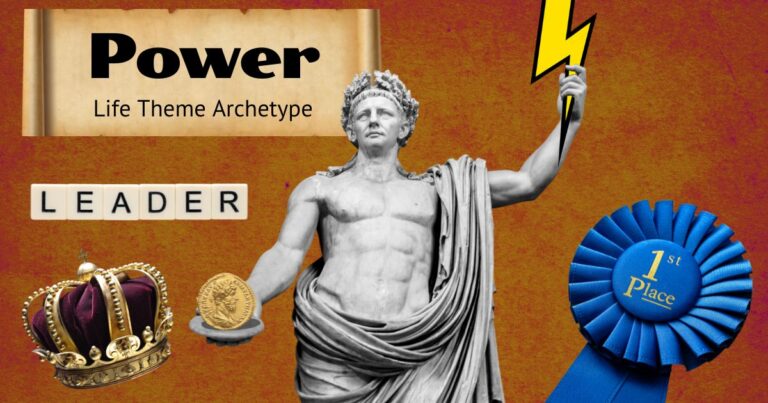
In my framework, people differ in their underlying motivational orientation. That orientation decides what they notice, what they value, and what eventually earns a place in their extended self. I describe it through four Life Theme Archetypes, which are Love, Justice, Wisdom, and Power.
Someone oriented toward Love tends to be moved by objects that carry relationship and belonging. A person oriented toward Justice often finds meaning in restoration and order, in returning something to the way it should be. Wisdom draws people toward what connects to learning and discovery. Power draws them toward what represents capability, agency, and results.
Consider an antique desk. To the first person it means a grandfather. To the second it means a careful restoration, to the third a piece of craftsmanship worth studying, and to the fourth a serious place to get work done. The desk is the same in every case. The meaning was never coming from the desk.
A Better Question to Ask About What You Keep
Try walking through your home with a different question than usual. Set aside whether something is attractive, expensive, or useful, and ask why it survived. Why this book, and not the dozens you gave away? Why this photograph out of thousands?
Then ask what would actually be lost if the object disappeared tomorrow. The answer might be a memory, a relationship, a stretch of your life, or a sense of who you were capable of being. Some of what you own is simply clutter that never got sorted. But the objects that earned their place did so for a reason, and once you find it, you are no longer talking about the object.
You are talking about yourself.
Frequently Asked Questions
What is the psychology of sentimental objects?
It is the study of why people form emotional attachments to certain possessions. Those attachments usually form when an object becomes linked to a memory, a relationship, a former version of the self, or an identity a person is still building.
Why is it so hard to let go of sentimental items?
Part of the answer is neurological. Yale research found that discarding possessions activated brain regions linked to emotional conflict and pain in people who hoard, and a milder version of that response appears in ordinary attachment. Loss aversion adds to it, because giving something up registers as a loss rather than as having one less item.
What is extended self theory?
Extended self theory comes from consumer researcher Russell Belk. It describes how possessions become part of a person’s identity rather than remaining separate from it, so that over time the things someone keeps and uses blur into their sense of self.
How can I tell if an object is meaningful or just clutter?
Ask what would be lost if it disappeared. If the answer is a memory, a relationship, a former self, or a sense of who you’re becoming, the object likely matters. If nothing comes to mind beyond the object itself, it is probably clutter.
The Story Your Belongings Already Tell
The psychology of sentimental objects comes down to a simple observation. People keep what carries their meaning. A memory, a person, a past role, or a future ambition can attach itself to something ordinary, and once it does, the object becomes a small record of the self. Looked at together, the things a person refuses to let go of tend to point in the same direction. Following that direction back to the Life Theme Archetype beneath it turns a decision about clutter into something more useful. It shows you what has mattered to you all along, often long before you could put it into words.