The Authentic Self Exists
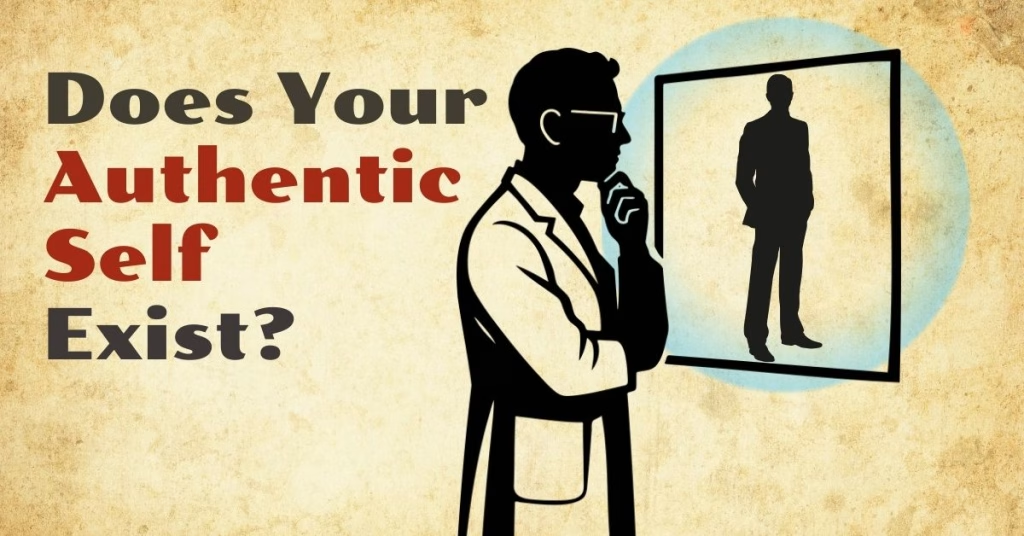
Recently, I came across an article in a highly regarded professional journal I found quite unsettling. The author proposed the idea that the “Authentic Self” doesn’t really exist and that “there is no mysterious ‘Authentic Self’ that needs to be discovered.” Then added that the search for your Authentic Self is futile, consumes a lot of mental energy, and detracts from your capacity to create the reality you desire.
I am shocked at this idea given the decades that academics, scholars, psychologists, and philosophers have dedicated their lives to proving the existence of an Authentic or often called, a Core Self.
And it came as no surprise that the person who wrote it was not a philosopher, but a medical doctor. This happens when a non-philosopher attempts to interpret a philosophical concept. To search for who we are is to search for authenticity. Expertise in a subject matters.
The concept of authenticity has deep roots, but the modern version of it traces back to the Existentialist movement and in particular to philosopher Soren Kierkegaard. He viewed every decision we make as a chance to choose our own values, and thus shape our identity.
For another renowned thinker, Heidegger, the core of a person goes beyond the “I” that experiences and performs actions. He believed that our true self is a continuous process of self-creation and self-expression through what we do. All our actions are interconnected and form a cohesive whole, giving us a sense of order through consistent reasoning.
Today, this idea of the Authentic Self has become commonplace in various discussions. It’s often described as being genuine to oneself, letting one’s actions reflect one’s intuition, and resisting undue influence from others. In essence, it’s about being true to who you are at your core, living a life that reflects your values and beliefs. Yet, this recent article challenges these established notions, suggesting that the Authentic Self may be an illusion rather than a reality and “furthermore, looking for it only creates frustration in the form of your self-critical voice.”
The Interplay of Genetics and Choice in Shaping Who We Are
Our DNA plays a major role in shaping our authentic selves. It acts as a sort of guiding force, helping to focus our values and generate specific motivations. This process fuels our unique sense of existence in the world. Everywhere in nature, there’s a genetic blueprint that dictates how each species will develop. Look at the animal kingdom, and you’ll see this uniformity. Each species—from antelopes to spiders, dogs to cats, fish and beyond—has its own unique genetic map that shapes its development.
We humans are part of this natural order, too. But what sets us apart is our ability to consciously shape our identity through our actions and choices. We’re not just passive recipients of our genetic blueprint; we’re active participants in shaping our subjective identities. So, while our DNA sets the stage for who we are, we as humans have the unique ability to write our own stories. And that’s what makes us so unique in the animal kingdom.
How Genes and Environment Shape Our Identity
Delving into our Authentic Self, we find it extends beyond the boundaries of language and logical reasoning. Our profound sense of self is indescribable, unable to be fully expressed. This identity exists before the constructs of language and logic, making any attempt at a complete linguistic depiction fall short.
To truly grasp this core identity, a comprehensive approach is required, incorporating elements such as personal values, emotions, and beliefs. These aren’t isolated aspects; they’re firmly rooted in your fundamental identity, contributing to the intricate mosaic that forms your “self.”
From a historical perspective, external influences often shape our identity, usually as caregivers in our early life, telling us what matters and who we should strive to become. We may submit to this pressure, allowing others’ desires to become our inner voice, leading to an existential crisis when we fail to live up to these expectations. This disconnection from our true self-expression can cause anxiety and potentially destructive behavior.
We are not mere machines programmed by others. Parents often chart the initial path of our lives. Their values, expectations, and behaviors significantly shape ours. Siblings, as our first peers, also play a critical role in molding our personalities. Interactions, competition, and camaraderie with them can shape our social skills, competitive spirit, and sense of belonging. Teachers and employers influence our professional development, guiding and challenging us, offering opportunities to learn and excel. They help shape our work ethics, ambitions, and career paths. Social norms and societal expectations further mold our destiny, defining what is acceptable or unacceptable and influencing our beliefs, attitudes, and behaviors.
The interaction between our genetic makeup and environmental influences is known as the nature-nurture debate. Our genes provide a blueprint for development, but our experiences and environment can modify how this blueprint manifests.
For instance, while our genes may predispose us to certain behaviors or traits, our environment can either nurture or suppress the expression of these genes. A child might be genetically inclined towards musical talent, but without access to musical instruments or education, that talent may never fully bloom. While our genes lay the foundation, our experiences and environment orchestrate the performance. We are not merely products of our genes or our environment, but a complex mix of both.
The Benefits of Authenticity
Never underestimate the significance of your Authentic Self. It is vital to always listen to the intuitive and absolute truthful advice it provides in our inner landscape. Be courageous in this pursuit.
The pursuit of aligning with your Authentic Self is not in vain. It’s simple to grasp, and it plays a critical role in shaping your preferred reality. Recognizing your genuine self is the key to leading a fulfilling life. Your Authentic Self is a beacon, guiding you through the complexities of life. It whispers truths that align with your deepest values and desires, even when external voices attempt to drown it out.
There will never be a day when you have fully actualized or expressed a completed Authentic Self. Each day brings new opportunities for growth and evolution. Authenticity is an inherent part of us all. It is not something that can be measured or needs to adhere to any specific set of standards. It’s about being true to oneself, embracing your individuality, and not succumbing entirely to societal or external pressures.
So, keep listening to your inner voice. Keep honoring your Authentic Self. Its wisdom is invaluable, and its guidance, irreplaceable. The journey towards authenticity is not just about self-discovery, but also about self-creation. It is a journey worth embarking upon, a journey that leads to a fulfilling and meaningful life.
Never forget: your Authentic Self is your truest guide and your greatest strength. And it exists.