The Cost of Western Science Distortion to the Human Essence

The modern confusion around meaning, self, and purpose is rooted in a profound western science distortion of core philosophical insights, a paradigm perfectly illustrated by the simplification of Abraham Maslow’s work. When most people think of Abraham Maslow, they imagine a bright, multicolored pyramid of the “Hierarchy of Needs” stacked neatly from survival to self-actualization. It’s a tidy image that seems to make sense: first eat, then love, then dream.
But here’s the truth: Maslow never drew a pyramid.
He never said one need must be completely fulfilled before another begins. That famous triangle wasn’t his; it was corporate America’s reinterpretation, a marketing simplification meant to turn a rich theory of human motivation into a productivity chart.
The “pyramid of needs” was never a discovery of human psychology. It was a distortion of it.
And that distortion is far from isolated. Across the past century, Western science has quietly reshaped, reduced, and sometimes outright betrayed the original insights of European psychology and philosophy—those thinkers who first explored the depths of consciousness, meaning, and being. The result is a culture that can measure everything except what matters most: what it means to be human.
The Maslow Misrepresentation
Maslow described motivation as fluid, overlapping, and dynamic. He saw self-actualization not as a destination but as an ongoing state of becoming. He wrote that people seek love while struggling with safety. They pursue meaning even amid hunger. To him, human motivation was a living system.
Yet in the hands of management consultants in the 1960s, his ideas became something far more useful to industry, the mighty pyramid. It presented human life as a checklist: once the base is satisfied, move to the next level. It was perfect for corporate handbooks, perfect for control, and perfectly false.
That same pattern of distortion repeats across nearly every major European thinker who dared to describe the interior life.
Western science distortion affects this through its psychological reduction of Maslow’s living system to a static pyramid was not an isolated event. It was a symptom of a deeper allegiance. Beneath the rhetoric of truth and objectivity lay a commitment to something far more utilitarian: control. Western science wanted the human being to fit within a framework that could be quantified, predicted, and applied. And in doing so, it exchanged depth for data, essence for efficiency.
Every major European thinker who attempted to describe the living interior world of humanity, especially those who spoke in the language of meaning, symbol, and spirit, was eventually filtered through this same rational sieve. Their ideas were translated into charts, typologies, and formulas that could be studied in classrooms or packaged into corporate seminars. What had once been living philosophies meant to awaken the human experience became management tools meant to optimize performance.
The distortion was subtle at first. Concepts like “self-actualization,” “the unconscious,” or “will to power” began as profound attempts to articulate the hidden forces animating human life. But as they entered the Western academic machine, these living insights were dissected until only their skeletons remained. The mystery was removed. The human being became a problem to be solved rather than a mystery to be lived.
This is how Western science tamed its prophets. It took thinkers who had revealed the depth of human interiority and repurposed them as instruments of social order.
To understand what was lost, we must revisit these thinkers not as psychological figures, but as symbolic ones. Each representing a stage in the collapse of meaning and the search for its return.
The Pattern of Distortion
Nietzsche: From Inner Creation to Ruthless Competition
Friedrich Nietzsche’s “Will to Power” was never about domination over others. It was about self-overcoming, the inner drive to create values and to become who one truly is. It was a call to authenticity and creativity.
But the Western industrial mindset reinterpreted it as social Darwinism, aggression, and ambition. The “will to power” became “the drive to win.” Nietzsche’s self-transcendent philosophy was transformed into corporate leadership rhetoric.
Systems built on competition cannot afford philosophies that celebrate inner freedom; they prefer ambition to authenticity.
Freud: From Mythic Depth to Marketable Neurosis
Sigmund Freud opened the door to the unconscious, revealing that human beings are shaped by hidden motives, dreams, and repressed desires. His work was steeped in myth and tragedy and the exploration of the symbolic life.
But Freud’s depth was soon diluted. Pop psychology turned his insights into simple categories like the id, ego, and superego. Pharmaceutical culture reduced the psyche to a chemistry set. “Therapy” became symptom management; the unconscious became a marketing tool; the essence of what it is to be a human became an algorithm.
Freud’s warning about repression was never meant to be medicated away. It was meant to be understood. But understanding takes time, and time is not profitable.
Husserl: From Lived Meaning to Data Point
Edmund Husserl’s phenomenology was a revolution. He argued that consciousness is intentional, that every perception, thought, and feeling is directed toward meaning. We do not observe the world from the outside; we constitute it from within. Reality, to Husserl, was a lived relationship between being and meaning.
Yet in American hands, phenomenology became “user-centered design.” A philosophy that once sought to restore meaning to life was recast as a strategy for improving product interfaces.
The richness of lived experience was flattened into “data about experience.” Once again, meaning was replaced with measurement.
Heidegger: Being Buried Beneath Productivity
Martin Heidegger dared to ask the oldest and most dangerous question: What does it mean to be?
He argued that modern humans have forgotten Being itself, that we live surrounded by things but disconnected from their meaning. His call to authenticity was a call to remember our place in the world as participants rather than consumers.
Yet his work was dismissed by mainstream psychology as “too abstract” or reduced to existential gloom. Authenticity cannot be commodified; a person who understands the meaning of their existence is not easily manipulated. They cannot be programmed to perform.
Piaget and Others: From Living Knowledge to Standardized Metrics
Jean Piaget’s research on children revealed that knowledge is constructed, not given. Each child builds understanding through active engagement with the world. Learning, for him, was an act of creation.
Once again, industry intervened. His ideas became developmental checklists, school benchmarks, and IQ scores. Education traded wonder for compliance. Students were taught what to think rather than how to mean.
Gestalt psychology suffered the same fate, transformed from a profound philosophy of wholeness into a handful of optical illusions. And Scheler’s axiology, a hierarchy of spiritual values rooted in love and reverence, was replaced by corporate “value statements” and quarterly surveys.
The Structural Cause
What ties these Western science distortions together is not a conspiracy but a paradigm.
Western science, since the Enlightenment, has been governed by three unquestioned assumptions:
- Reductionism, the belief that to understand something, you must take it apart.
- Positivism, the conviction that only what can be measured is real.
- Instrumentalism, the idea that knowledge is valuable only if it can be used.
These assumptions created a world that can build rockets but cannot answer why we should launch them. A world that can measure happiness but cannot produce it. A world that has confused efficiency with essence.
The result is alienation.
The Cost to Americans from Western Science Distortion
When economics lost its moral foundation, it ceased to be about human life and became a game of numbers. Value was no longer measured in the enrichment of human experience but in the movement of digits across screens.
The great financial collapse of 2008 revealed this detachment in full: nearly nineteen trillion dollars vanished, along with millions of homes, jobs, and futures. It wasn’t just a financial failure—it was a philosophical one. Institutions built elaborate models to measure value, yet never paused to ask what value meant. Had the insights of the early European thinkers who studied human action as purposeful and value-driven been taken seriously, this collapse might never have occurred.
But the modern world trusted formulas over meaning, and in doing so, it reduced the living world of exchange to an abstract equation.
The same blindness appears in our psychology. We live in an age where more than half of college students report overwhelming anxiety, where depression and suicide among the young have doubled within a generation. It’s not that people have nothing to live with; it’s that they no longer know what to live for. Western psychology, once born from philosophy’s concern with the soul, has turned the self into a project to be managed.
The deeper language of meaning: of calling, purpose, and inner identity has been replaced by the metrics of performance and chemical balance. We treat existential suffering as a technical malfunction, attempting to medicate away a spiritual hunger. The modern psyche is not sick because it feels too much, but because it has forgotten what its feelings are for.
This disconnection begins early. Education, which once meant “to draw forth” what lies within the student, now means to download what lies outside. Children are instructed to choose careers, not callings; to memorize, not to understand; to conform, not to become. The symbolic understanding of life which is the sense that knowledge should reveal who we are has been stripped from our curricula.
Philosophy is dismissed as impractical, art as ornamental, imagination as childish. By adulthood, most people can analyze a spreadsheet but cannot interpret the meaning of their own existence. We have raised generations of brilliant technicians who feel like impostors in their own lives.
Technology has only deepened this estrangement. We now live beneath the invisible governance of algorithms that predict our desires before we feel them. Every click, every pause, every choice is recorded, analyzed, and resold. The very process of discovering who we are has been replaced by a system that tells us who we are supposed to be.
Technology no longer serves humanity. It defines it. Heidegger warned that technology was never neutral; it was a way of revealing the world. What it now reveals is the reduction of the human being to a measurable unit of attention, a self that exists only insofar as it can be monetized.
All of this leads to a deeper fracture—a collapse of coherence. Without a shared sense of meaning, truth itself becomes negotiable. We can no longer agree on what is real, what is good, or what is beautiful. This is not merely a political division; it is a spiritual disintegration. At its root lies the same problem that haunts every domain of modern life: a worldview that removed human essence from science and replaced Being with doing. We gained mastery over the mechanics of the world, but lost our understanding of why the world matters.
The result is a civilization that can manipulate almost everything yet understand almost nothing. We are surrounded by tools that can calculate, predict, and replicate but cannot tell us who we are. This is the essence of Western science’s distortions.
Until we restore the living center of meaning to every domain of life, we will continue to refine the instruments of our own confusion. What has been lost is not intelligence, but wisdom; not progress, but purpose. And this loss, more than any economic, political, or scientific failure, marks the true cost of the modern age.
The Disappearing Self
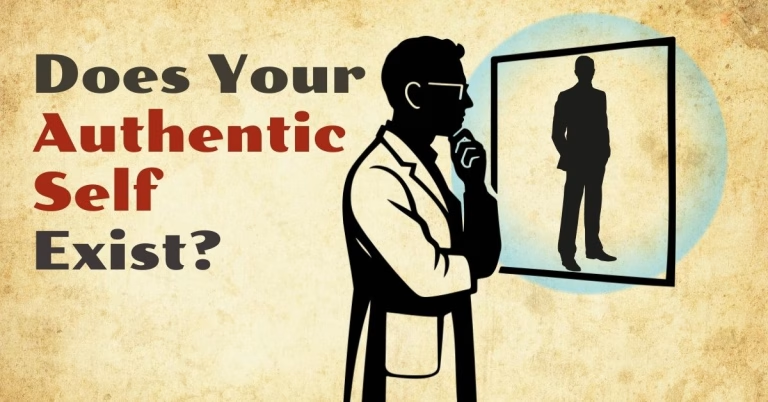
The most devastating loss has been the disappearance of identity itself. A century of behavioral conditioning, standardized education, and psychological reductionism has disconnected people from their Authentic Self—the unique, living core that gives coherence and purpose to existence.
In its place, we have over valued and over developed the Synthetic Self, a patchwork identity built from roles, expectations, and social feedback. It can function but it cannot fulfill. It performs but it cannot feel.
This fragmentation explains why even success feels hollow. Without symbolic understanding, without the language of meaning, life becomes a series of activities without orientation.
Authentic Systems: Restoring the Lost Architecture of Meaning
Authentic Systems exists to reverse this long distortion. It restores the missing dimensions of psychology by reuniting philosophy, symbolism, and identity into a coherent whole.
Through phenomenology, we recover the experience of meaning.
Through axiology, we restore the hierarchy of values.
Through the Life Theme Archetypes Love, Justice, Wisdom, and Power we reveal the motivational architecture that gives every person their unique way of being in the world.
This is not another “system” to manage behavior; it is a map back to wholeness.
Authentic Systems does not measure you. It mirrors you. It reconnects you to the deep coherence between what you feel, what you value, and what you do.
A human being is not a product of parts.
We are systems of meaning.
The Path Forward through Western Science Distortion
If Western science has built the pyramid, then it is time to take it down. Not to discard knowledge, but to free it from distortion and rebuild a worldview that honors both truth and transcendence.
That begins when we reject simplification for the sake of convenience, return to the original sources unfiltered by institutional agendas, place meaning before measurement, value Being over doing, and restore soul to science and authenticity to psychology.
The future of humanity depends not on how much we know but on how deeply we understand. Maslow never built a pyramid; we did.
It’s time we remembered what he and so many others were truly trying to tell us:
We are not here to climb levels.
We are here to express our Authentic Self.