
Understanding Maslow’s Misinterpretation and His Real Vision
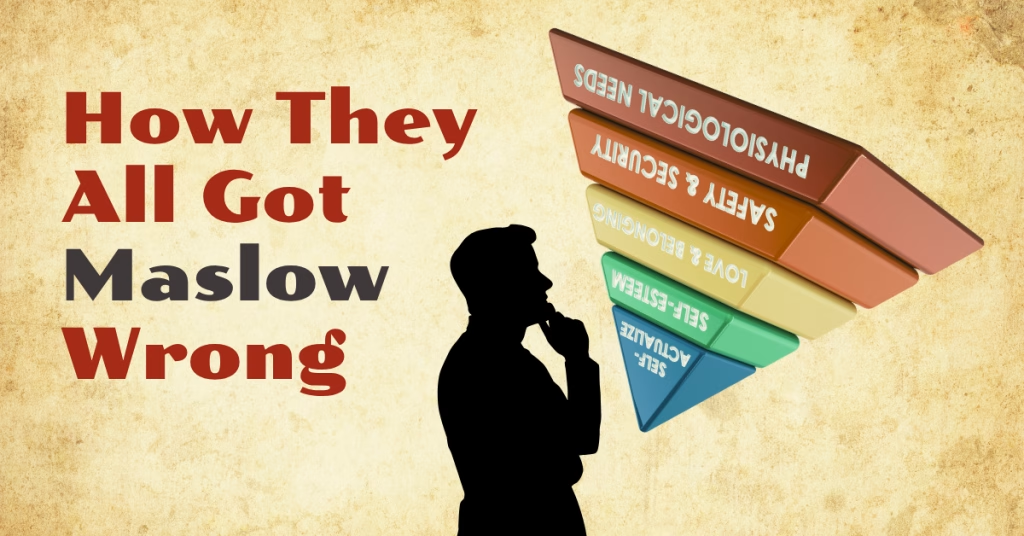
The Hierarchy
Have you ever wondered what truly drives the people around you? We could turn to the famous pyramid of self-actualization, but Maslow’s misinterpretation has skewed this perspective. Recognizing the motivations behind others’ actions can transform not only your understanding of other people but also the quality of your relationships with them. By comprehending the “why” behind someone’s desires, you can build empathy, enhance communication, and strengthen personal connections.
This idea is central to the work of Abraham Maslow, an influential American psychologist. In his groundbreaking book, A Theory of Human Motivation, Maslow explores the dimensions of human needs and aspirations by offering insights that continue to resonate today. Understanding what motivates other people can lead to richer, more meaningful interactions and pave the way for mutual respect and collaboration.
Maslow presents a revolutionary view of human motivation in his foundational work using a hierarchical structure of needs. From simple physiological needs to the search for self-actualization, his comprehensive approach exposes the range of what motivates human beings. This all-encompassing model can help us better see how our needs interact and shape our actions.
However, soon after the publication of A Theory of Human Motivation, the American corporate world accepted but reinterpreted Maslow’s observations, turning them into the well-known “Maslow’s Hierarchy of Needs.” Few know that Maslow himself did not create this famous pyramid model. Rather, it has evolved into a useful instrument for training in American and marketing and psychology.
Maslow points out that motivations are not synonymous with behavior for humans. Rather, motivation is one category to trigger behavior. Human behavior also includes biology, culture, and situations. For Maslow, visualizing our innate drives in this orderly way simply helps us to clarify the main forces influencing our life and goals.
It should be noted that Maslow often described motivation as needs, forces, and also drives. I mention this because Maslow did not use the word “need” in a strict and absolute sense, which is why I prefer the words “drive” or “force.” After all, humans have often willingly gone without water, food, or shelter as an act of protest. And suicide bombers are certainly willing to do without even air to breathe in order to express their life’s meaning. Maslow was certainly aware of the structural foundation for value and meaning in identity.
The following are the five dominating levels of motivation that drive human behavior. Starting from the bottom up, these five needs are:
5) self-actualization (fulfilling one’s potential).
4) esteem needs (acknowledgment and respect from others),
3) love/belonging needs (relationships with others),
2) safety needs (security and stability),
1) physiological needs (food, water, shelter, etc.),
Maslow’s hierarchy is an indicator of our dominating motivations to act in general. However, many business schools have turned this great idea into a strict pyramid with each rung of the ladder marking a required accomplishment before moving higher on the ladder—ignoring Maslow’s humanistic viewpoint of our fundamental wants and motivations.
Maslow disagreed with this view, believing they are steps of importance but need not be fully satisfied before seeking to fulfill another drive. In fact, he said, “… this may give the false impression that such needs have an all-or-nothing relationship to each other. This may lead one to believe that a previous need must be fully satisfied before the next one can be addressed.”
The field of psychology is still misrepresenting Maslow as found in “Problem Solver, Psychology.” They not only repeat this gross misrepresentation but claim he believed people who are still motivated to satisfy the lower needs are characterized by a tendency to be self-centered and concerned with their own needs.
He repeatedly said needs and drives are dynamic and holistically sought after all at once and according to opportunity. This same pyramid approach was used in the book to describe motivation and job satisfaction, which could never be effectively implemented. This oversimplified approach misses the dynamic and linked character of human wants. Actually, our goals are erratic, overlap and affect one another in intricate ways.
Understanding the fluidity of the actual meaning of Maslow’s hierarchy may help us welcome a more complex knowledge of what really motivates us. Maslow was closer to Gestalt psychology by emphasizing a holistic approach rather than the misinterpreted lock-step hierarchy portrayed through Western writers. Gestalt has been described as a dynamic fusion found in the Humanistic movement. Rather than advancing a pyramid of representation of a fixed hierarchy, Gestalt is one of many sources for the Authentic Systems approach to human motivation, capturing the whole individual.
Maslow’s Misinterpretation, and How Needs Are Not Simple
Maslow’s exploration of human motivation invites us to move beyond simplistic models and acknowledge the profound complexity of our needs. By understanding these needs are fluid, interconnected, and often unconscious, we gain a richer perspective on what drives us and those around us.
When we add the four needs of the Life Theme Archetypes to his model, we see there is a deeper awareness that challenges the rigid hierarchy of the pyramid. It demonstrates the dynamic nature of human behavior—where physical, emotional, and mental needs overlap and influence one another in meaningful ways.
The physiological needs of food, water, and shelter, etc. are instinctual and found in the animal kingdom and are not dependent on human motivation. However, it is easy to see the similarities between Maslow’s outline of human cognitive desires and Authentic Systems Four Life Themes:
5) self-actualization (fulfilling one’s potential).
Self-actualization occurs through seeking change in becoming our potential. This requires a Power Life Theme.
4) esteem needs (acknowledgment and respect from others),
Self-esteem and respect are learned from our social environment and linked with our knowledge of life represented by the Wisdom Life Theme.
3) love/belonging needs (relationships with others),
Love, belonging and relationships of course resonate with the Love Life Theme.
2) safety needs (security and stability),
Safety is a dual-inferred motivation, comparing what is present in the environment and what should be in place for comfort and survival. This drive is shared with the Justice Life Theme.
By adopting this more complex view, we recognize that every individual is navigating their own unique path toward self-actualization. It reminds us, too, of the importance of nurturing our own process of authentic self-expression that is tethered to our Life Theme Archetype. When we honor this shared human experience, we create space for connection, growth, and a more profound sense of fulfillment in our lives.