Essence, Form, and Content: Understanding Identity Archetypes

In my methodology of understanding identity archetypes, the distinction between essence and form becomes essential for explaining two things:
- How a person can remain recognizably the same individual across an entire lifetime while beliefs, occupations, relationships, skills, and behaviors continually change.
- How can there be over 8 billion people in the world, and yet each person is completely unique.
I would argue that without distinguishing between essence, form, and content, unique identity becomes fragmented into temporary experiences rather than understood as an enduring continuity. This article is going to create definitions around essence, form, and content as they relate to the four Life Themes as identity archetypes.
What is Essence?
Essence refers to the deepest motivational core of the person — the inherited genetically structured archetypal Life Theme. This provides the enduring center of identity. Every person possesses all four archetypes of Love, Wisdom, Justice, and Power, yet one and only one emerges as the organizing center of identity for life.
What is observable is expressed motivation. This motivation is the authentic essence of being. It is not behavior, personality, preference, or social identity. Rather, it is the motivational orientation that constrains what kinds of experiences, meanings, and expressions will feel psychologically authentic to the individual. It is important to know that gene clusters form to express emotional biases to what you don’t like. By eliminating what you don’t like, what remains is open to possibilities of acceptance.
Imagine Mel goes to the kitchen faucet and turns it on, and rather than crystal-clear water, there is a brown discoloration as if the line had broken and dirt seeped in. Obviously, she cares for her family and decides to call a neighbor to learn if they are having the same problem. That would make a difference in resolving Mel’s issue. She calls Jessica, and she too complains about dark water. Jessica hadn’t called the water company because she is leaving for the day and assumed it will be dealt with by the time she gets back. Mel however, had planned to stay all day at home, and it will be a hot day. Mel calls her local utilities district to inform them of the issue in the neighborhood. She wants to know the cause and what is being done about her contaminated water.
There are other variations of this brief story, but they all have the same essential qualities. Mel first noticed a change in the water clarity which is asymmetric to her past experience. Her immediate reaction is concern for the health of the family. She needs to know if this is affecting the neighborhood or just her house. Mel knows that the only way this is to return to normal is if the utility gets into action, investigates the problem. Recognition of a change in the water and concern, are moments of awareness but need to know and physical action expands from awareness and into rational purposeful thought.
To understand the identity archetype in Mel’s case:
Recognition of asymmetry begins the process of what is and what should be justified.
Concern is caused by caring with the ultimate expression being love.
The need to know offers facts to lead into a wise assessment.
Now knowing the results of this asymmetric situation, the utilities are needed to change the situation back to symmetry require will to power.
To retain a cohesive motivational structure, the Life Theme is needed as the gatekeeper to life experiences.
- She could have called the utility to express her need to care, as a Love Life Theme.
- She could have called the utility to express her need to know as a Wisdom Life Theme.
- She could have called the utility to express her need for change, as a Power Life Theme.
- Yet she called the utility to express her need for symmetry as a Justice Life Theme.
This dominant Life Theme functions as an enduring motivational authentic essence that remains stable throughout life in order to retain and empower a cohesive interpretation of self while surrounded by chaos. It is authentic by containing a biological original structure of self.
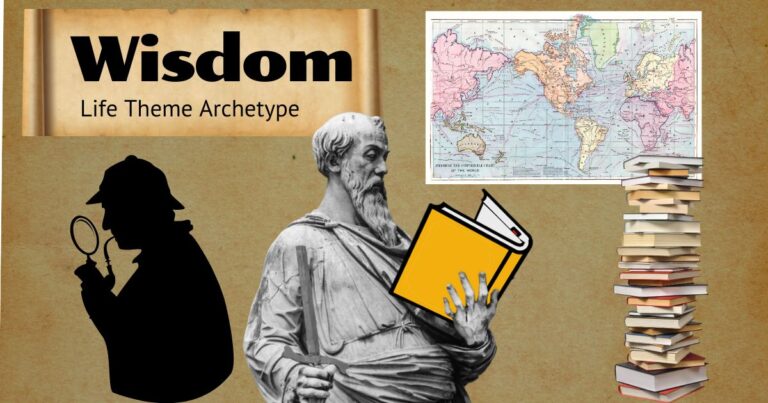
A person with a Wisdom essence, for example, is fundamentally oriented toward understanding, knowledge, insight, and meaning. This does not determine specific actions or careers. One Wisdom-oriented person may become a contractor, another a philosophy professor, another an inventor, pilot, detective, or entrepreneur. What remains constant is not the behavior but the motivational direction — an emotional attraction toward understanding, explanations, learning, and intellectual coherence as a way to separate understanding from chaos.
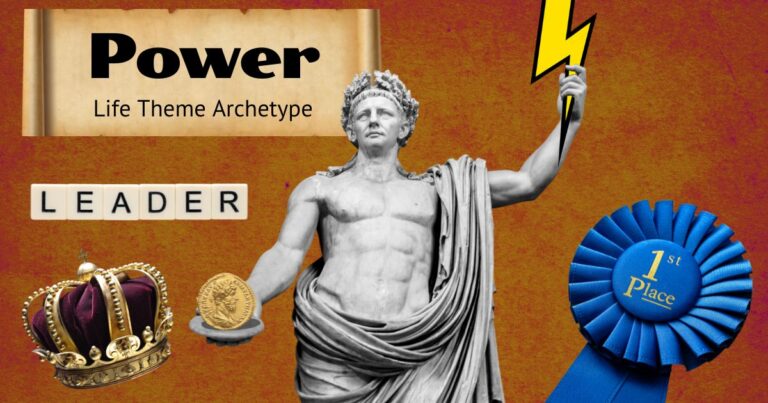
Similarly, a Love essence seeks care, connection, and compassion; a Justice essence seeks harmony, fairness, and symmetry; and a Power essence seeks agency, transformation, and effective action. This motivating Life Theme functions as the essence of who we are and therefore answers the question: What fundamentally motivates this person?
What Is Form?
Form, in contrast, refers to the stable psychological structure through which the essence organizes experience. If essence is the enduring motivational “why,” form becomes the enduring psychological “how.” Form is the organizing pattern through which the Life Theme expresses itself in cognition, emotional organization, decision-making, relationships, empowerment, and meaning-making. It represents the architecture through which essence becomes psychologically visible.
For example, a Wisdom essence may express itself through different forms and types of knowing. One person may become highly theoretical and abstract, another holistic and synthesizing, another technical and problem-solving, while another becomes highly detailed and analytical. Though the expression differs, the underlying organization remains recognizably Wisdom-oriented.
The same principle applies to the other Life Themes. A Love essence may express itself through nurturing, teaching, healing, mentoring, or service; a Justice essence through restoring harmony, balancing systems, law, mediation, or ethics; a Power essence through leadership, building, organizing, production, or transformation. Form therefore answers the question: How is this motivational essence psychologically organized and expressed?
What Is Content?
Content is the manifestation of occupations, beliefs, political affiliations, relationships, traumas, achievements, failures, cultural influences, and social roles. These are a posteriori as they are shaped by lived experience and environmental interaction. Content changes constantly throughout life. Yet content is never psychologically neutral because it is interpreted through form, which itself expresses the underlying essence.
This distinction explains continuity without rigid determinism. A father and son may both possess a Wisdom essence and yet live entirely different lives — one becoming a contractor and the other a philosophy teacher. Although the content of their lives differs dramatically, the motivational form remains recognizable. Both may display an enduring fascination with understanding, explanation, systems, mastery, or insight. The inherited essence constrains the range of psychologically authentic possibilities while still leaving enormous room for variation in life expression.
Research shows that much of modern psychology mistakenly confuses content with identity itself. Political beliefs, jobs, labels, temporary emotions, personality traits, or social roles are often treated as “the self”, despite changing repeatedly over the lifespan. Yet identity continuity depends upon an enduring motivational essence expressed through stable psychological form. Without such a center, it becomes difficult to explain why people retain a coherent sense of self across decades, why family motivational similarities recur, or why choices feel meaningful rather than arbitrary.
In this way, using the four archetypes helps us understand identity development as an unfolding relationship between essence, form, content, and lived experience. Essence provides motivational direction. Form provides enduring structure. Content provides the experiences through which identity is expressed. A person changes continuously across life, yet beneath those changes remains a recognizable organizing center that gives continuity, coherence, and meaning to becoming.
Knowing the difference between essence, form, content, and lived experience reveals what we can, could, should and must change in our daily life expression and if that change is even necessary to find happiness and contentment.
This knowledge will begin to explain why you might feel frustrated, angry, or disappointed in your life.